






 Spell
 Normal
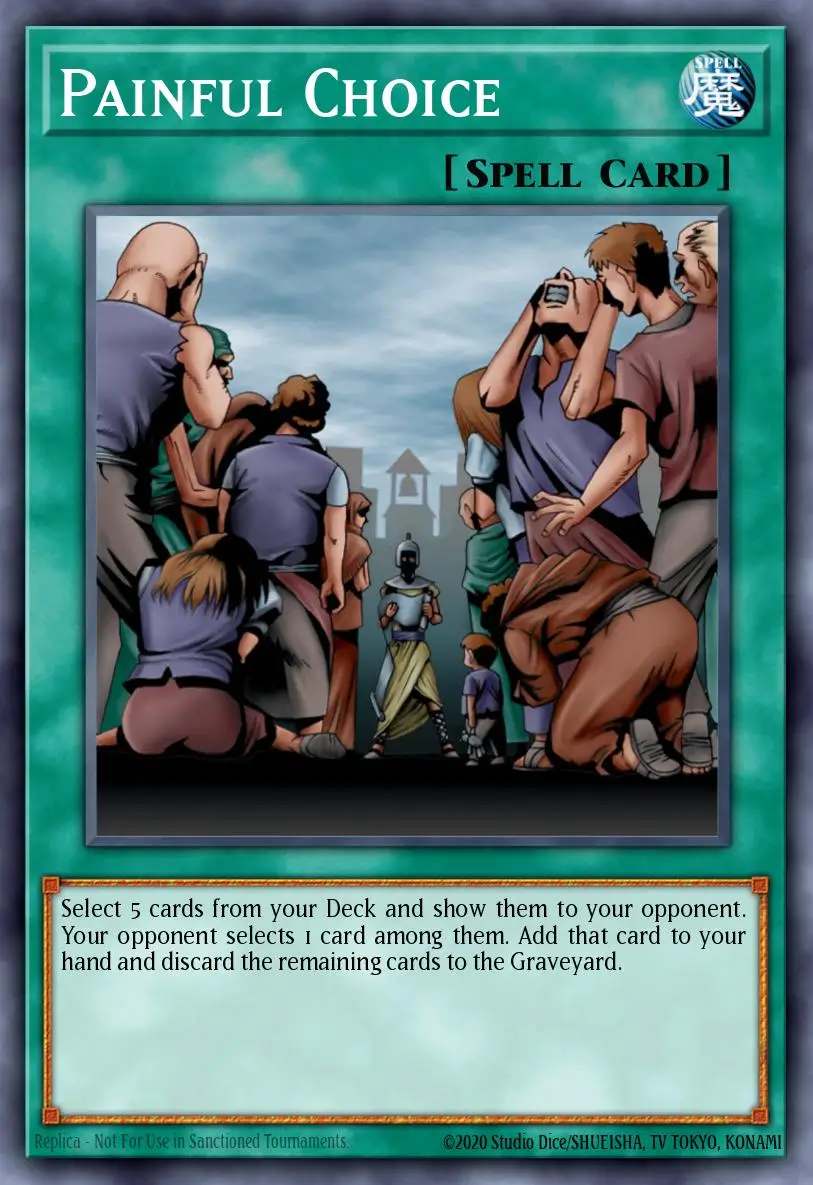
Painful Choice
View:
7218
Select 5 cards from your Deck and show them to your opponent. Your opponent selects 1 card among them. Add that card to your hand and discard the remaining cards to the Graveyard.


Painful Choice — Power Evaluation
Final Score: 53 ± 7 · Confidence: Medium
- Intrinsic: 61 · Deck: 64 · Meta: provisional
- Primary role: Searcher/Tutor · Secondary: Resource Economy, Recovery/Recursion
Why it scores here
Painful Choice is a flexible deck searcher that generates incidental milling value, making it a staple across 20 distinct GOAT-format archetypes (Black Luster Soldier 31%, D/D/D 22%, Jinzo 16%). However, its power is fundamentally capped by opponent control over which card is searched, reducing reliability compared to unrestricted tutors. The card is banned in all modern formats (TCG, OCG, MasterDuel with zero legal copies), making this a purely historical evaluation within the GOAT metagame.
Axis scores
| Axis | Score | Evidence |
|---|---|---|
| Accessibility | 75 | In GOAT format (the only legal environment), it is a main-deck staple appearing in 83 decks with 1.29 average copies; opponent agency on the search reduces accessibility compared to pure tutors (verified: deck data shows 83 main/0 side). |
| Combo & Conversion | 55 | No combo data supplied; text inference shows milling 4 cards + searching 1 generates moderate resource value, especially in GY-dependent archetypes like D/D/D (21.7% inclusion); opponent control further caps combo reliability (inferred from archetype distribution). |
| Resource Economy | 75 | Milling 4 + searching 1 card nets GY advantage in graveyard-reliant strategies, corroborated by 91.6% co-occurrence with Pot of Greed and 89.2% with Graceful Charity, indicating placement in a draw-milling engine (observed: top partners). |
| Effect & Interaction | 10 | As a normal spell with zero disruption, it provides no opponent interaction; the opponent's card selection is an agency loss rather than a strategic interaction (verified: description contains no negation/removal/disruption). |
| Material Utility | 0 | Spell cards cannot serve as synchro, xyz, fusion, or link material; material utility is zero (verified: spell card type). |
| Resilience & Flexibility | 45 | Once resolved, the search and milling are permanent effects, but the spell has no mid-game recovery or multi-turn presence; appears across 20 distinct archetypes indicating robust redundancy across homes (observed: distinct archetypes 20). |
| Deck-Building Efficiency | 80 | Runs cleanly as 1–2 copies with no garnet risk (always activable); efficiency is confirmed by 100% main-deck rate (83/83) and 80.7% in gameplay type 7, fitting seamlessly into GOAT draw engines (verified: decks running it in the Main Deck 83, formats distribution). |
Calculation
Weight profile: Searcher/Tutor role. Intrinsic ≈ 61, Deck ≈ 64, Meta = provisional. Modifiers: Forbidden in all formats (-10). Final formula: 0.40*Intrinsic + 0.60*Deck
Strengths
- Flexible search across 5 displayed cards (tutor reach)
- Incidental milling as secondary effect (resource for GY decks)
- Clean inclusion with no brick or garnet risk (always activable in hand)
- Staple across 20 distinct archetypes (strong redundancy and portability in its era)
- Efficient deckbuilding cost (1–2 copies, no lock or deck restriction)
Weaknesses
- Opponent controls which card is searched (fundamental reliability loss vs. unrestricted tutors)
- Milling can be negative in non-GY archetypes (Harpie, pure combo-focused strategies)
- Banned in all modern formats (TCG, OCG, MasterDuel) — historical/nostalgia only
- No disruption or interaction capability (spell-only, no combat relevance)
- Single-activation spell (no multi-turn presence or recovery path)
Counters / choke points
- Graveyard-exile effects (Macro Cosmos, Dimensional Fissure, banish-on-mill mechanics)
- Deck archetypes that do not benefit from milling (pure Xyz/Synchro combo lines)
- Modern hand traps (if this card were ever unbanned in modern formats)
Best use
Searcher with incidental milling for GY resource decks. Decks: Black Luster Soldier, D/D/D, Jinzo, GOAT-format goodstuff.
Evidence & gaps
- Verified: Card text: search 1 of 5 shown cards, opponent chooses; mill 4 cards to GY; Banlist status: illegal (0 legal copies) in all listed formats; Deck inclusion: 83 decks, 20 archetypes, avg 1.29 copies per deck; Top partners are all GOAT-era staples (Pot of Greed, Graceful Charity, Yata-Garasu, BLS-EOB); Format origin: GOAT era (early 2000s Yu-Gi-Oh!)
- Observed: Primary homes are Black Luster Soldier (26 decks), D/D/D (18 decks), and Jinzo (13 decks); 100% main-deck rate across sample (0 side-deck inclusions); 91.6% co-occurrence with Pot of Greed and 89.2% with Graceful Charity indicate placement in draw-heavy engines; 80.7% of runs in gameplay type 7 (a GOAT metagame classification)
- Inferred: Combo conversion: milling 4 cards provides GY value generation in decks built for graveyard resource use; Opponent's choice mechanism reduces search reliability below unrestricted tutors; Material utility is 0 because spells cannot be synchro/xyz/fusion/link material; Accessibility in modern formats is 0 (banned), but was high in GOAT
- Data gaps: No combos supplied — combo conversion is text-inference only; cannot measure empirical combo centrality or board power generation No guides supplied — no human strategy commentary or archetype-specific usage advice No usage statistics (StatisticsCard rows) — relying on 83-deck sample only; cannot confirm consistent inclusion % across larger historical samples No modern format context — card is banned in all listed formats, so no current metagame data; evaluation is purely GOAT-historical No ruling edge cases — text is clear, but opponent agency interactions and timing edge cases are unstated